
First World War · Christmas 1914 · For worship and reflection
A True Christmas Story to Read Aloud: The Candles Were Still Burning
A true story to read aloud, about eight minutes long, for Sunday worship, carol services and Advent gatherings. It takes place at Christmas 1914 on the River Oise in northern France, and it rests on a letter, a battalion war diary and a sergeant’s account from those very days. Below you will find a short version for a sermon, three reflections with Bible readings, hymns, prayers, an order for a short service, and everything to print or to edit.
The Candles Were Still Burning
Reading time about eight minutes
To begin, in your own words: The story I am about to read is true. It happened at Christmas 1914 in northern France, in the first winter of the First World War. Every word in quotation marks was written down by soldiers who were there.
The letter begins with an address you will not find on any map: ‘Stone cave, 23 December 1914.’ Beneath it, Captain von Düring writes to his wife. The first line is still a Christmas greeting: ‘So tomorrow is Christmas Eve.’ The second is not: ‘If the French meant to spoil our Christmas, they have made a thorough job of it.’
Then he writes about the fighting of the past few days. Forty-five men of his company are dead. Forty-five families are waiting for a Christmas letter from the front that will never come.
The cave lies in northern France, south of the village of Carlepont, not far from the River Oise, between Compiègne and Noyon. There are hundreds of caves like it in the limestone of this country. They are old quarries, where people once cut the stone for their houses out of the hillside. Now soldiers live in them. Since the autumn the 89th Grenadier Regiment, from Mecklenburg on Germany’s Baltic coast, has held this ground, in trenches, dugouts and caves. The rock shields the men from the shells. It gives them no peace.
Opposite them lie the French of the 42nd Infantry Regiment. To them this rock is not foreign soil. It is their own. Carlepont and the villages around it have been occupied by German troops since the autumn. Every man who attacks here is fighting to win back his own country.
The regiment expects heavy attacks on Christmas Eve, too. But no attack comes. The day stays quiet, from morning until night.
And so the men from Mecklenburg keep Christmas in the stone. In the war diary of one of their battalions, where attacks and losses are usually recorded, the writer finds other words that evening. He describes an altar decked with fir, just as it had been a few days earlier for Holy Communion. ‘From the midst of it’, many little candles cast ‘their friendly glow into the cave’. Outside, the night is clear and full of stars. There is, he writes, ‘a solemn, comforting stillness after the unrest and the din of battle of recent days’. Far and wide, German carols can be heard ringing through the night.
Almost every man has had post from home over the past few days. The parcels are called Liebesgaben, ‘love gifts’, and so many arrive that a mocking rhyme soon goes round the front. It lists everything that love sends, from scarves to soap – ‘love-candles light my evenings’ – and ends with a sigh: ‘so much love … and not a girl in sight!’ Some parcels do not even come from a man’s own family. All over Germany, strangers are packing parcels this winter for soldiers they have never met.
‘The men are cheerful and confident’, notes the war diary. They smoke the cigar from their parcel or their Christmas pipe, and, the diary says, ‘many a peaceful picture rises before our mind’s eye’.
What those pictures are, nobody writes down. We can guess. A front room that smells of pine. A child allowed to stay up late tonight. A woman reading a letter written in a cave – and reading it a second time, searching between the lines for how he really is.
On Christmas Day the French attack with all their strength. The fighting turns into a bitter struggle, man against man, right inside the German positions. In the evening, men of the 76th Regiment from Hamburg come to the aid of the badly weakened Mecklenburgers. By then it is dark, and the darkness holds everything where it lies. No one can bring in the dead now. No one can carry the wounded away or march the prisoners to the rear.
That night, in the German trenches and in front of them, lie more than two hundred and fifty dead, Germans and French. Among them lie the wounded. More than a hundred and forty Frenchmen have been taken prisoner. They are distributed among the dugouts.
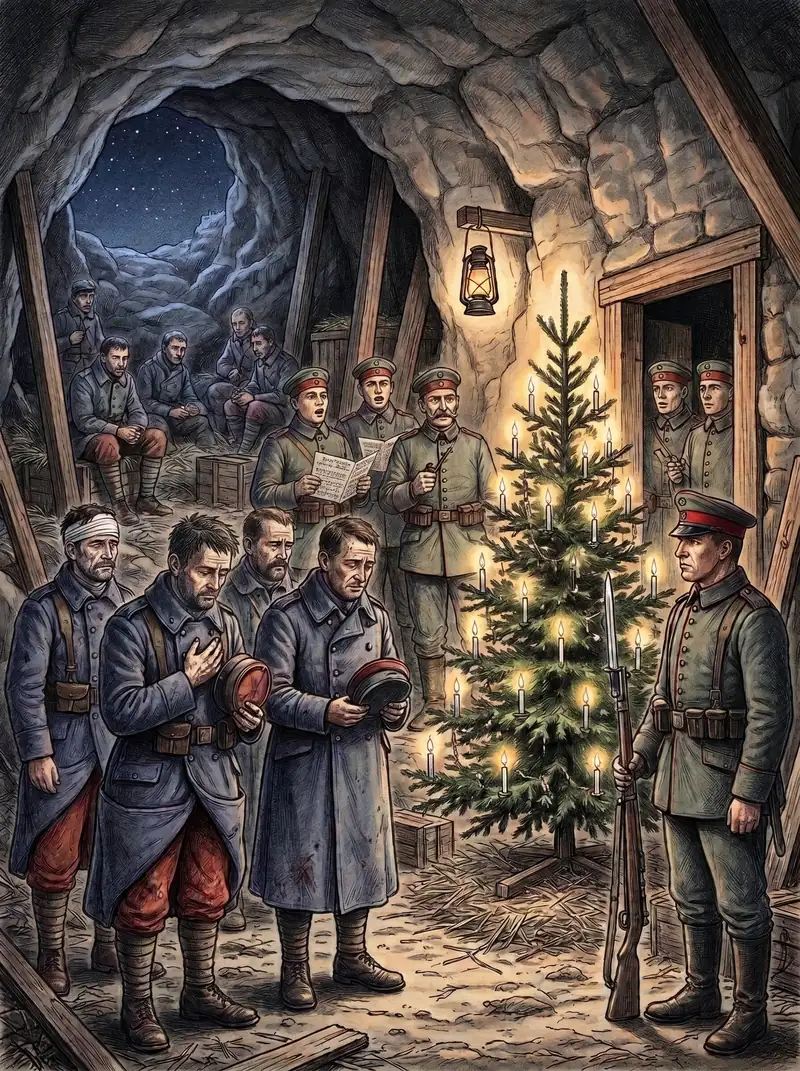
A sergeant of the 2nd Company wrote down what happened next: ‘When the attack had been beaten off and all was quiet again, we went back into the cave. There a moving sight met our eyes.’
In front of the room where the prisoners are held, the big Christmas tree is still standing. Its candles are burning. A few grenadiers stand guard before it, bayonets fixed. And then something happens that no army regulation provides for: the singing starts again. ‘Once more Christmas carols rang out’, the sergeant writes, ‘and one could plainly see what an impression this made on our enemies.’
Some of the Frenchmen step up to the tree. Men who only that day had charged this very position. They take off their caps. They say a few words. They cross themselves. ‘Many a wet eye was to be seen among them.’
What they said, nobody recorded. Perhaps a prayer. Perhaps the names of their children. Perhaps a single word: Noël.
But the sergeant writes a sentence that stays with you: ‘They too were surely thinking of wife and child at home, and were glad to have come out of it alive.’
They too. That morning these men had been the attackers. Now they stand unarmed in the candlelight, and the man guarding them recognises in them what he knows of himself. They too have a home. They too are glad to have lived through this day.
No one on the Oise tells of handshakes in no man’s land. But for the next three days the guns on this stretch of the front fall silent. Then the war goes on, for almost four more years. Whether Captain von Düring came home, whether the prisoners ever saw their children again, we do not know.
The sergeant did come home. After the war he wrote: ‘Everyone who came back from the field and lived through that Christmas will always remember those days when Christmas comes round.’
Nothing more has come down to us. A tree in an old quarry. A few candles. Men with rifles and men without. Some singing, some weeping. And all of them standing in the same light.
The tree belonged to neither side. It shone as brightly for the guards as for the prisoners.
Christmas 1914 is long past. Yet this Advent, too, candles are burning, in churches and in windows, in cellars and shelters in cities at war. And what the men in the cave on the Oise saw for one evening is still true: a light does not ask which side you are on. It shines for us. And for the others too.
Short version to retell
About two minutes, to weave into your own sermon or address.
Christmas 1914, northern France. A regiment from Mecklenburg in north Germany is dug into old quarries near Carlepont on the River Oise. On 23 December a captain writes to his wife that the French have thoroughly spoilt their Christmas. Forty-five men of his company are dead.
But Christmas Eve stays quiet. In the caves, candles burn among fir branches, and carols ring out through the starry night.
On Christmas Day the French attack again. By evening more than two hundred and fifty men lie dead in and in front of the trenches, Germans and French. More than a hundred and forty Frenchmen have been taken prisoner.
Afterwards a sergeant goes back into his cave. In front of the prisoners’ room the big Christmas tree is still standing, and its candles are burning. Carols are sung again. Some of the prisoners step up to the tree, take off their caps, say a few words and cross themselves. Many have tears in their eyes. Later the sergeant writes: ‘They too were surely thinking of wife and child at home.’
No one there describes a Christmas truce. But that evening, guards and prisoners stood before the same light. And the tree shone as brightly for all of them.
For worship and reflection
Three reflections for a sermon
1. The light shines in the darkness (John 1:5; Isaiah 9:2)
The story glosses over nothing. On the evening of Christmas Day more than two hundred and fifty men lie dead outside the cave. And inside, the tree stands and its candles burn. The light does not wait until the darkness is over; it comes into the very middle of it, as it did on the first Christmas night. The historian who went through the regiment’s records almost left it at the casualty figures; only then did he come upon the accounts of the evening by the tree. How often do we stop looking too soon – in the news, in the world, in our own lives – and miss the lights that are still burning?
2. One sun for the evil and the good (Matthew 5:44–45; Ephesians 2:14)
Jesus says, ‘Love your enemies’, and he grounds it in the sky above us: God makes his sun rise on the evil and on the good. The tree in the cave did the same. It shone for the guards and for the prisoners. And people prayed before it in different ways. Most of the grenadiers from Mecklenburg were Lutherans and had received Communion a few days before; the Frenchmen crossed themselves, as Catholics do. Two nations, two traditions, one light. Of Christ the letter to the Ephesians says: ‘he is our peace’, who has made the two one and ‘broken down the dividing wall’.
3. The little word ‘too’ (Luke 2:14; Hebrews 13:3)
The most important sentence in the story hangs on one small word. ‘They too were surely thinking of wife and child at home’, the sergeant writes of men who had been his enemies that morning. Peace begins in that ‘too’: wherever I recognise in another person what I know of myself. At Christmas God becomes human, and since then no human being is only an enemy. The angels’ song of ‘peace on earth’ is not only for those on our side. The letter to the Hebrews goes further still: remember those in prison as though you were in prison with them. Who do we see this Advent only as an opponent? And what would happen if, just once, we said ‘too’?
Hymns
| When | Hymn |
|---|---|
| To begin | O Come, O Come, Emmanuel |
| After the story | Angels We Have Heard on High (in Britain often: Angels from the Realms of Glory) |
| After the prayers | It Came Upon the Midnight Clear |
| To close | Silent Night |
All four are in most hymn books, under different numbers. ‘Angels We Have Heard on High’ (in many British churches sung as ‘Angels from the Realms of Glory’, to the same tune) is the French carol ‘Les anges dans nos campagnes’, so a French carol rings out in your church, just as it does in German churches to the same tune. ‘It Came Upon the Midnight Clear’ was written in 1849; one of its verses speaks of ‘man, at war with man’ and calls on ‘ye men of strife’ to hush the noise and hear the angels sing.
Prayers of intercession
God, you came into the world on a night when no one was expecting you. You know the darkness and the cold. To you we bring our prayers.
We pray for all who are living through war this Advent, in trenches, cellars and tents. Let lights burn where they can see no hope.Lord, in your mercy – hear our prayer.
We pray for all prisoners, and for all who are waiting for word of someone they love.Lord, in your mercy – hear our prayer.
We pray for all who face one another as enemies, between nations, in churches, in families. Give them an evening when they see the human being in the other.Lord, in your mercy – hear our prayer.
We pray for the dead of every war whose names no one remembers, and for all who mourn them.Lord, in your mercy – hear our prayer.
We pray for ourselves. Give us the courage to take the first step, instead of waiting for the other to begin.Lord, in your mercy – hear our prayer.
God, your light does not ask which side we are on. Let it shine on us and on all those we do not understand. We ask this through Jesus Christ our Lord. Amen.
A short service of about twenty minutes
- Hymn: O Come, O Come, Emmanuel
- Welcome and the opening words
- The story (about eight minutes)
- A minute’s silence
- Hymn: Angels We Have Heard on High (or Angels from the Realms of Glory)
- One of the three reflections, or a conversation using the questions below
- Prayers of intercession and the Lord’s Prayer
- Hymn: It Came Upon the Midnight Clear
- Blessing, then Silent Night
Tips for reading aloud
- Two voices: a second reader takes the words from 1914 in quotation marks, so the listeners hear who is speaking.
- Candles: a small arrangement of fir with candles stands at the front. Light the candles when Christmas Eve begins in the story, and let them burn to the end.
- The story is not suitable for children’s services or nativity plays.
Questions for reflection and conversation
- On 23 December the captain writes that Christmas has been thoroughly spoilt. One evening later, candles are burning on the altar. What can a single quiet day change?
- The prisoners go to their enemies’ tree, of all places. What are they looking for there?
- Some sing, some weep. Is that comfort, triumph, or both?
- ‘They too were surely thinking of wife and child at home.’ About whom do we find it hard to say that ‘too’?
- Is there someone in our family, our street or our church with whom we have long been dug into separate trenches? What might be a first light for them?
What is documented
Everything in quotation marks comes from sources of the time and is translated from the German: Captain von Düring’s letter of 23 December 1914, the war diary of the 2nd Battalion and the account of a sergeant of the 2nd Company, written after the war. The military historian Christian Lübcke studied them for the German War Graves Commission (Volksbund Deutsche Kriegsgräberfürsorge). The place, the dates, the figures, the French regiment, the reinforcements from Hamburg and the rhyme about the love gifts all come from his account. French sources confirm that Carlepont and the villages around it were occupied from the autumn of 1914, and that hundreds of old quarries in the Oise and the Aisne sheltered soldiers.
Only the pictures we can guess at and the sentences with ‘perhaps’ are told rather than documented. The altar is described in the war diary of the 2nd Battalion, the tree in front of the prisoners by the sergeant of the 2nd Company; they may have been two different caves in the same position. The sergeant writes that the French took off their ‘helmets’. Here it says caps – French képis – because French soldiers were not issued steel helmets until the summer of 1915. We do not know the names of the prisoners or of the sergeant, nor the captain’s first name.
Print and pass it on
The story is available as a PDF to print, set large for reading aloud, and as a Word document you can shorten and copy into your service sheet, both with the short version, reflections, hymns, prayers, order of service, questions and the source.
Story and material for worship as a PDF7 pages A4 · with source line and QR code · 97 KBThe same material as a Word document to editfor service sheets, parish magazines and carol services · 17 KB- Reading aloud
- free, in worship and in public: at carol services, in groups and in the family
- Reprinting
- free of charge in parish magazines, church newsletters, diocesan papers and community newsletters, in print and online; you are welcome to shorten it
- Worship
- the reflections and prayers may be used and adapted freely
- Please
- print the source line directly below the text when you reprint it
- Copy for our records
- We would be glad to receive a PDF at presse@humane-weltformel.de.
Source line: Text: Bernd Blasius, author of The First to Stand Up (Edition Resonanz, 2026). To read aloud and print: humane-world-formula.com/christmas-truce-1914/christmas-story
More about the Christmas Truce
Elsewhere on the front, Christmas 1914 brought a real truce, with carols across the trenches and handshakes in no man’s land. You can read what happened there on our page The Christmas Truce of 1914: What Really Happened
The book: The First to Stand Up

The First to Stand Up – The Christmas Truce of 1914 and the Courage to Leave Our Trenches by Bernd Blasius tells the story of that night from the letters and records of the men who lived it, and asks what it means for the trenches we dig at our own tables.
Read a sampleMore about the book
Order here
Coming soon. The order links will appear here.
In paperback, hardback and as an e-book.
Also on
The e-book is also available from Apple Books, Kobo and other shops.
As an Amazon Associate I earn from qualifying purchases.
Sources
Checked on 5 November 2026.
- Christian Lübcke, German War Graves Commission (Volksbund): „Stille Nacht, heilige Nacht“? Der Traum vom Weihnachtsfrieden (23 December 2024, in German)
- Chemins de mémoire (French Ministry of the Armed Forces): Carlepont and Cuts, ‘Le parcours des Zouaves’ (in French)
- Observatoire du Centenaire (University of Paris 1): La caverne du Dragon – underground quarries in the Aisne and the Oise (in French)
- G. Thomas: Quand le Service de santé faisait « carrières » (in French)
- Wikipedia: Adrian helmet