
Read a sample
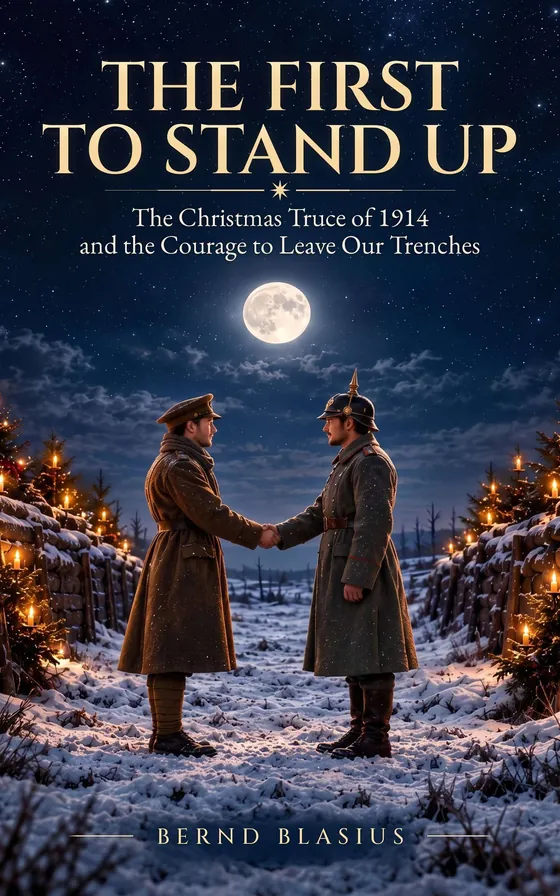
The First to Stand Up
The Christmas Truce of 1914 and the Courage to Leave Our Trenches
The prologue and Chapter 2 in full. About twelve minutes’ reading. More about the book
PrologueThe Thinnest Silence of the Year
There is a silence that is peace. And there is a silence that only holds its breath.
As a child, I knew the second kind better than any carol. It came into our house on the morning of 24 December, long before dark, and it did not leave until everyone was in bed. Nobody had invited it, and nobody ever spoke of it. But every one of us knew it was there.
On that day my mother, my sister and I moved differently. More quietly. More carefully. We laid the table as though one knife out of line could set something off. We chose our words as if they were made of thin glass. We were three people with one plan: this evening was going to be lovely. And my father was not going to find a single reason to blow up.
His expectations of that evening were enormous, and it was our task to live up to them down to the smallest detail. In those years I learnt to read moods the way other children learn to read their first books. A clearing of the throat. A door that shut a shade too firmly. A sentence that began a shade too loudly. Everything was a message, and you dared not miss one.
In the evening, the waiting began. We children were not allowed into the room with the tree until the bell rang. Behind the closed door something was happening that we were not meant to see, and we stood outside, listening for the bright chime that would tell us: the Christ Child has been.
In that waiting, hope and fear lay so close together that I could no longer tell them apart. The hope that this time it would be a lovely evening. The fear that once again it would not be enough, however hard we tried.
It took very little to tip an evening like that over the edge.
For a long time I believed that on those evenings we were fighting for peace. Only much later did I understand that what we were defending was something else. The language of war has a more precise word for it than the language of families: ceasefire. A calm that holds only as long as nobody puts a foot wrong. A calm that has to be earned afresh every minute.
There is one night when it was exactly the other way round.
It, too, was a Christmas Eve – more than a hundred years ago, in the first winter of the First World War, in the fields of Flanders and northern France. There, men lay opposite one another, every man in his own trench, under orders to kill each other. Between them lay a strip of ground full of barbed wire and the dead, and any man who put his head above the parapet could pay for it with his life. If there was ever a place where no one could expect peace, it was this one.
In those trenches shivered farmers and bakers, teachers and students, postmen and miners, some of them not yet twenty. That evening many of them were thinking of those at home, keeping Christmas without them. Some had already lost a friend, and not one of them knew whether he would live to see the morning.
And yet, that night, the men began to sing. ‘Silent Night’, of all songs.
The next morning many of them climbed out of their trenches unarmed and walked towards one another. They shook hands. They buried their dead together. They swapped whatever they had on them and showed each other photographs from home.
In our house, people who were meant to love one another lived under a ceasefire. Out there, people who were meant to hate one another found real peace, for one night.
I no longer remember when I first heard of that night. It has not let go of me since.
This book tells its story and asks what it reveals about us: whether peace is a miracle that happens once, or something that lies waiting in every one of us.
Perhaps at Christmas you sit at a table where everything looks peaceful, and yet everyone is watching what they say. Perhaps in your family it isn’t one person’s temper but an old quarrel that nobody goes near any more. Or politics, which on this day of all days everyone would rather leave well alone. Perhaps this silence is no stranger to you.
Then this book is for you, too.
Because there is a difference between a silence that holds its breath and a silence in which you can breathe. The men of 1914 knew that difference. For one night, at least.
From Chapter 1 · Home by Christmas
But Christmas came all the same. For many of these men it was their first away from home. It came with the parcels and the letters, with the little trees, and with the frost that made the night clear. And it came with a question that many a man on both sides will have asked himself in those days: whether the men over there were thinking of home too.
On the evening of 24 December they were to hear the answer.
Chapter 2Lights over the Trenches
On Christmas Eve 1914 the moon hung over the fields around Armentières. It was the first bright night for a long time, clear and bitterly cold.
‘I think everyone felt very homesick on Xmas Eve,’ wrote an officer of a London battalion.
At half past six, British headquarters sent a warning to every corps: the Germans might attack over Christmas or New Year, and special vigilance was called for. Some units did not receive it until about a quarter to eight. So that evening the sentries stood in their trenches, rifles in numb fingers, eyes on the other side. ‘The silence was almost uncanny,’ the same officer wrote, ‘and we were all very suspicious and extra vigilant, expecting some trick.’ Ready for anything. Anything but what came.
At some point in the evening, lights appeared on the German side. Where no one could show himself by day, small flames shone. Candles. And when their eyes had grown used to the glow, the men saw what the candles were fixed to: little Christmas trees, set up along the trenches, one beside the other. In the still, frozen air the candles burnt without a flicker. ‘We did not trust each other at first,’ wrote a British rifleman.
Some of the sentries still had the warning ringing in their ears. And now there were lights along the enemy line. Was this the trick? The signal for the attack that headquarters had thought possible? Or something for which this war did not yet have a word?
Some answered the way they had been trained to. At one point, a corporal from Staffordshire wrote, the British were ‘knocking them down as fast as they put them up’. He feared that something would happen before morning; every night they expected an attack. Opposite a battalion from Hertfordshire, lights appeared above the German trench that looked to the British like Chinese lanterns, and voices called across. Before they could do anything, one of the soldiers remembered, the order came for rapid fire. The Germans did not shoot back. They simply carried on celebrating. His company spent the night in its wet trenches, making the best of a bad job.
Then, over there, they began to sing.
Along many stretches of the line the regiments opposite were Saxon, along others Bavarian. In the British accounts, what they sang was later called ‘Holy Night’. It was ‘Stille Nacht, heilige Nacht’: ‘Silent Night’.
The song that carried through the cold to the British lines was nearly a hundred years old that winter. And it had its own history of war and hunger.
In 1816 Joseph Mohr, a young curate in Mariapfarr in the Salzburg region, wrote a poem of six verses. Mohr was the illegitimate child of a poor knitter and a soldier who had deserted in the year his son was born. The land around him had two decades of war behind it. Napoleon’s campaigns had passed Salzburg from one ruler to the next, and in that year it became Austrian. Then there was the sky. On the other side of the world the volcano Tambora had erupted the year before, and 1816 went down in European history as the Year Without a Summer. The harvests failed. People went hungry.
Two years later Mohr was in Oberndorf on the Salzach, a village where many people were in debt, with no income and no bread. On 24 December 1818 he asked the schoolmaster and organist Franz Xaver Gruber for a melody for two voices and guitar. Gruber wrote it that same day. At Midnight Mass in the church of St Nicholas, the two men sang the song for the first time.
Here, in English, are lines from one of the six verses:
Where on this day all the power
of a father’s love poured forth,
and as a brother, full of grace,
Jesus embraced the peoples of the world.
A song written after years of war, in a time of hunger, about a brother who embraces the peoples of the world. Of all the verses, it was this one that later vanished from most hymn books. Usually only three of the six are sung.
Families of Tyrolean singers carried the song out into the world; from 1839 a family from the Zillertal sang it in America, and in 1859 an English version appeared. In time it was translated into more than three hundred languages and dialects. Many of the men singing it in the trenches opposite came from Saxony, where it had been heard at the Leipzig Christmas market as early as 1831.
The church where Mohr and Gruber first sang it no longer stood by the winter of 1914. Floods from the Salzach had damaged it so often that it was pulled down in 1913.
A song born of the hardship of a small village on the Salzach had gone round the world. That night it went across no man’s land.
The British listened. Then they answered with one of their own songs. Back and forth it went from trench to trench, a call and response through the night, song after song.
In one London battalion, as one of the men wrote, they had planned a Christmas present for the Germans that evening: ‘three carols and five rounds rapid’. When the carols had been sung, they paused before moving on to the second part of the programme. Then they heard the answer drifting across from the other side. Another British soldier later called it ‘a real Carol Concert’.
Rifleman Graham Williams of the London Rifle Brigade later described how it unfolded in his battalion. First the Germans sang one of their carols, then the British sang one of theirs. And when the British struck up a carol that was known on the other side as well, the Germans joined in at once. ‘I thought, well, this is really a most extraordinary thing,’ Williams recalled, ‘two nations both singing the same carol in the middle of a war.’
Sometimes instruments joined in. Opposite a battalion from Hampshire the Germans sang all night, and one of them played a few solos on the cornet. It had been grand to listen to them, wrote a bandsman of the battalion. When they played ‘God Save the King’, they called across: ‘What would the Kaiser say if he heard us playing this?’ Facing the London Rifle Brigade, Graham Williams’s battalion, the Germans even sang ‘God Save the King’ in English at midnight. Then someone over there made a speech, and others kept interrupting him with cheers.
The Germans knew the tune of the British anthem well. At home they sang their Kaiser’s anthem to it, ‘Heil dir im Siegerkranz’ – Hail to Thee in Victor’s Crown. Two anthems, one tune. Perhaps that night some of them sensed how much they shared: the trees, the songs, even this tune.
Between the songs, shouts flew back and forth, some in halting German, some in halting English. ‘Gentlemen, a Happy Christmas to you all,’ the Germans called to the Hampshire men. One London battalion heard: ‘A merry Christmas English, we’re not shooting tonight.’ Opposite the Staffordshire men, a lone voice in English asked them not to fire.
A British officer noted in those hours that the Saxons opposite were singing carols and ringing bells.
I know how a bell can sound on Christmas Eve when you do not know what will come after it. That night, what followed was a song.
On the German side, too, men wrote home in those days about what they were living through. Not a shot had been fired, a German soldier wrote to his wife on Christmas Day; they had smoked cigarettes and set lights on the edge of the trench. ‘The war was suspended. The Christmas peace had done it.’
The war diary of a Somerset battalion records that there was a great deal of singing on both sides that night. The Germans opposite brought their regimental band up to the front. It played their national anthem and the British one, and then ‘Home, Sweet Home’. Opposite the London Rifle Brigade, on one of those nights, Germans sang the song at about two in the morning, in English. They sang it ‘so beautifully that it positively made me cry’, a captain of the battalion wrote to his wife. His name was John Somers-Smith. At the 1908 Olympic Games in London he had won gold as an oarsman. In the summer of 1916 he was killed on the first day of the Battle of the Somme.
‘Home, Sweet Home’ is a song about home, sung by men who had not seen theirs for months. One of its lines long ago became a proverb: there’s no place like home.
The song had rung out between enemies once before. On 30 December 1862, during the American Civil War, the armies of the North and the South lay facing each other near Murfreesboro, Tennessee. In the evening the military bands on both sides played, and in every pause the other side’s music could be heard in the distance. Then one band struck up ‘Home, Sweet Home’. ‘As if by common consent, all other airs ceased,’ a soldier from Tennessee remembered, and ‘the bands of both armies as far as the ear could reach, joined in the refrain’. The next morning the battle began, and it lasted three days.
In 1914, though, the rifles often fell silent where there was singing. In the Royal Welch Fusiliers’ sector, officers agreed a truce across the lines. Opposite a battalion from Cheshire, the Germans signalled that they would not fire. Elsewhere they asked outright for an armistice.
Not everywhere was the music allowed to play on. In one sector the British artillery heard the sounds from the other side and fired towards them. The shells struck a German band. The war had its own answer to music.
Sometimes both answers came at once. Near Arras the stretcher-bearer Ernest Benoist lay with his regiment some two hundred yards from the Germans. That night a bullet grazed his face; he had very nearly been killed, he wrote. Someone over on the other side was playing an accordion, and Benoist thought he could hear a harmonium too. A French lieutenant climbed onto the parapet and struck up ‘Minuit, chrétiens’, one of France’s best-loved carols, known in English as ‘O Holy Night’. The Germans, Benoist wrote, listened as reverently as the French. Then they sang the ‘Marseillaise’ themselves, amid compliments and insults. And all the while the bullets went on flying back and forth, ‘with perfect regularity’.
But elsewhere the candles went on burning along the edges of the trenches, one beside the other. When the last songs had faded, a silence lay over the trenches such as there had not been for months. Not one that held its breath. One in which you could breathe.
The men lay in the cold, listening out for the other side. They had sung. They had called out to each other. But between the trenches the barbed wire and the dead still lay, and no one knew what the morning would bring.
Someone would have to be the first to stand up.
© 2026 Bernd Blasius. Extract from The First to Stand Up: The Christmas Truce of 1914 and the Courage to Leave Our Trenches. All rights reserved.
End of sample
Who stood up first, how the men met in no man’s land, and what that night reveals about our own tables – the book tells the rest.
Read on
Coming soon. The order links will appear here.
In paperback, hardback and as an e-book.
Also on
As an Amazon Associate I earn from qualifying purchases.