
First World War · Christmas 1914
Christmas Truce Football Match: Myth or Fact?
Yes, there was football in the Christmas truce of 1914 – but probably not the match most people picture. Letters written in the days after Christmas show British and German soldiers kicking a ball about together in no man’s land in a few places. What nobody has been able to prove is a proper game with two teams, a referee and a final score.
Did soldiers really play football in the Christmas truce?
The best evidence is what men recorded at the time, and careful collections of it turn up only a handful of first-hand accounts of football with the enemy. These are the main ones, with how close to the event each was written down:
| Who | When and how it was recorded | What it says |
|---|---|---|
| Company Sergeant Major Frank Naden, 6th Cheshires | January 1915, newspaper interview on home leave | Germans joined in football near Wulverghem, Belgium |
| Captain Coates, 1st Royal Fusiliers | Letter, 26 December 1914 | A ball went over to the German line and back near Chapelle d’Armentières; officers kept their men from crossing |
| A rifleman of the Queen’s Westminster Rifles | Letter printed in the Hull Daily Mail | The Germans at Houplines were invited to play and declined |
| Private William Tapp, 1st Royal Warwickshire Regiment | Diary, 25 December 1914 | Trying to arrange a match near St Yvon for Boxing Day |
| Captain James Jack, 1st Cameronians | Diary, December 1914 | The Argylls’ planned match with the Saxons was stopped by shellfire |
| War diary of the 2nd King’s Own Scottish Borderers | December 1914 | Passes on a report that a match was played – hearsay |
| A major of the Royal Army Medical Corps | Letter in The Times, 1 January 1915 | An unnamed regiment lost 3–2 to the Saxons |
| Lieutenant Johannes Niemann, Saxon 133rd Infantry Regiment | BBC interview 1968, regimental history | A game of about an hour near Frelinghien, 3–2 to the Germans |
| Ernie Williams, 6th Cheshires | Television interview, decades later | An informal game near Wulverghem, with no count of goals |
The official war diaries are almost silent. Plenty of them record football that Christmas – but between British units behind the lines.
What did the games look like?
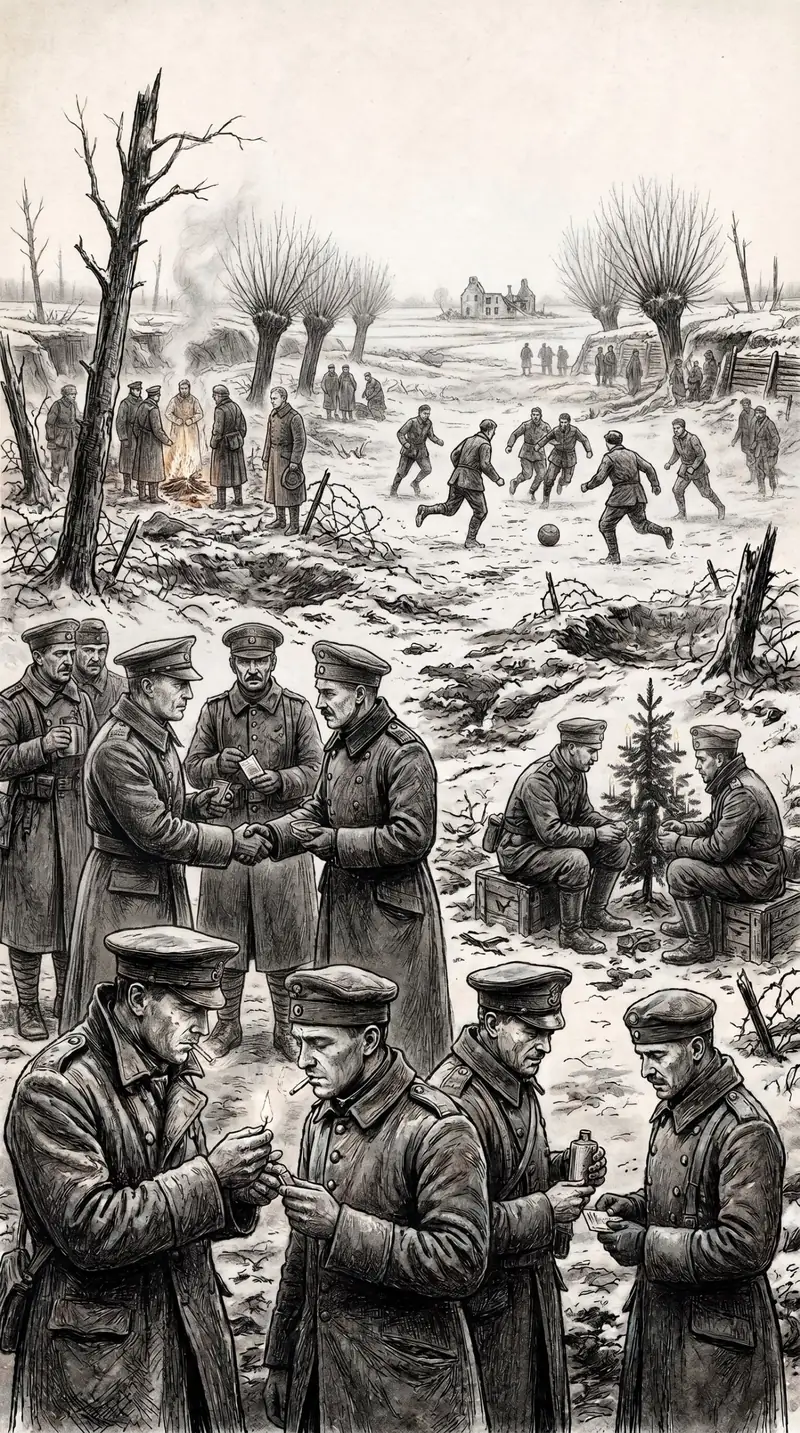
Nothing like a cup final. The ground the men played on was frozen hard, pitted with shell holes and strung with wire; in places it was a meadow or a cabbage field. Some battalions had footballs from home or from Christmas parcels. Where there was none, men made do: one later recollection speaks of an old tin, and an officer of the Rifle Brigade described his platoons playing among themselves with a woollen cap comforter stuffed with straw.
Was there a real match with a score?
Two accounts give a result, and both say 3–2 to the Germans. The first appeared in The Times on 1 January 1915: a major of the Royal Army Medical Corps wrote that a regiment, its name left blank, had played the Saxons and lost 3–2. The second came more than fifty years later from Johannes Niemann, in 1914 a lieutenant in the Saxon 133rd Infantry Regiment. In a BBC interview in 1968 and in the regiment’s history he described a game of about an hour between Frelinghien and Houplines, against Scottish soldiers, probably the 2nd Argyll and Sutherland Highlanders. Whether the two reports describe the same game, nobody can say. The 133rd’s war diary has not survived, and the British battalion diaries mention no match.
Other matches were planned for Boxing Day and never played. Shellfire stopped the Argylls’ fixture, and another Highland officer wrote that headquarters forbade a game. The historian Iain Adams, who has studied the accounts in detail, concludes that a formal match is doubtful, but that informal kickabouts very probably happened.
Where was football played?
The accounts of football come almost entirely from one short stretch of front either side of the Belgian–French border, where British battalions faced Saxon and other German regiments: around Wulverghem and Ploegsteert in Belgium, and at Frelinghien, Houplines and Chapelle d’Armentières in France. Belgian and French soldiers also met the Germans that Christmas, on the Yser and further south, but football is not part of what they reported.
Is there a photograph of the football match?
No. None of the genuine photographs of the truce shows a ball. One of the best known, taken by Lieutenant Cyril Drummond, shows Royal Dublin Fusiliers and Saxons standing together in no man’s land. The picture shared every December of soldiers playing on a dusty field was taken a year later, in December 1915, near Salonika in Greece.
Why did football become the symbol of the truce?
In 1914 football was the favourite game of the working men who filled the ranks, and many battalions carried a ball with them. Newspapers picked up the football letters in January 1915, veterans talked about them in interviews from the 1960s onwards, and the centenary in 2014 put the kickabout in the spotlight: football associations held ceremonies, and a supermarket’s Christmas advert was built around a game in no man’s land. A ball is easy to picture and easy to retell. Something almost every account mentions – the burial of the dead – rarely makes it into the retellings.
Christmas truce football memorials and statues
- Saint-Yvon near Ploegsteert, Belgium: a monument unveiled on 11 December 2014 by UEFA president Michel Platini, a football resting on a shell.
- National Memorial Arboretum, Staffordshire, England: the Football Remembers memorial, unveiled on 12 December 2014 by Prince William as president of the Football Association. It was designed by Spencer Turner, a ten-year-old from Newcastle, who won a competition open to schools across the UK.
- Liverpool, England: ‘All Together Now’ by Andy Edwards in the garden of St Luke’s Church, a British and a German soldier shaking hands over a football.
- Neuville-Saint-Vaast, northern France: the monument to the fraternisations of the whole war, with figures of French, British and German soldiers and a football.
The football myth in the classroom
Our free teaching resource has a worksheet that puts the football accounts side by side, so students can judge for themselves what counts as evidence. Go to the teaching resource
Everything else about the truce – where it happened, how it began and what came after – is on our page The Christmas Truce of 1914: what really happened
The book: The First to Stand Up
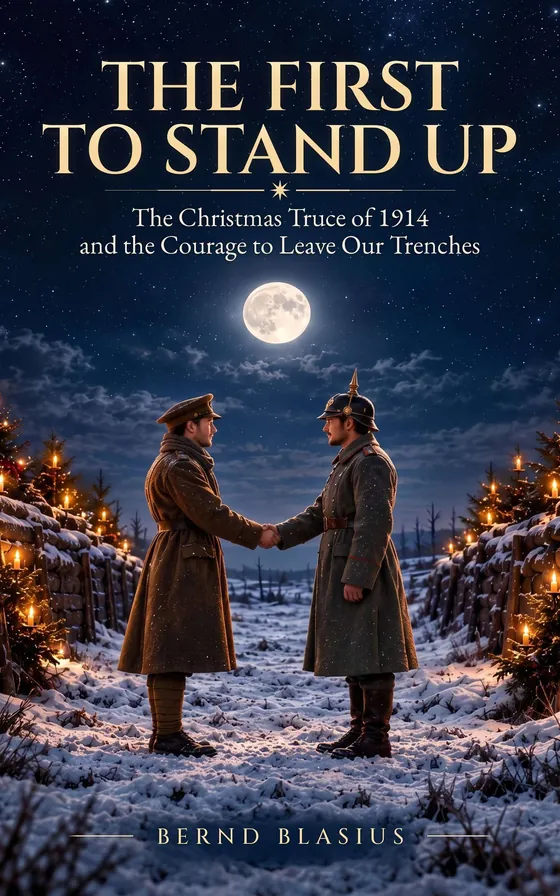
The First to Stand Up – The Christmas Truce of 1914 and the Courage to Leave Our Trenches by Bernd Blasius tells the story of that night from the letters and records of the men who lived it, and asks what it means for the trenches we dig at our own tables.
Read a sampleMore about the book
Order here
Coming soon. The order links will appear here.
In paperback, hardback and as an e-book.
Also on
The e-book is also available from Apple Books, Kobo and other shops.
As an Amazon Associate I earn from qualifying purchases.
Sources
Checked on 1 November 2026.
- Iain Adams: A Game for Christmas? (University of Central Lancashire)
- The Long, Long Trail: Legends, myths and realities – the Christmas Truce, 1914
- Football and the First World War: The Christmas Truce and football
- The National Archives: The game of Christmas football on the Western Front
- The Conversation: The Christmas truce football match – a picture of a Greek kickabout is misappropriated yearly
- Ian Jones, Great War Forum: Christmas Truce 1914 – Gunners (Drummond photograph, IWM HU 35801)
- DH: Platini inaugure le monument de la Trêve de Noël (11 December 2014)
- The FA: HRH The Duke of Cambridge unveils Truce memorial (12 December 2014)
- Art UK: All Together Now, Liverpool
- Ministère des Armées: the fraternisation monument at Neuville-Saint-Vaast