
First World War · Christmas 1914
The Christmas Truce of 1914: What Really Happened
In the first winter of the First World War, something happened that no general had planned and no government had approved. On Christmas Eve 1914, along stretches of the Western Front, the shooting faded. Men who had spent weeks trying to kill each other left the shelter of their trenches, crossed into no man’s land and greeted the enemy with a handshake.
What was the Christmas Truce?
The Christmas Truce was not one ceasefire but many. There was no agreement between the armies and no order from above. Instead, small groups of soldiers made their own arrangements, sector by sector, sometimes only for a few hundred metres of trench.
By December 1914 the war that was meant to be over by Christmas had dug itself into the ground. A line of trenches ran from the Belgian coast to the Swiss border. In places the enemy was less than a hundred metres away, close enough to hear voices and shout across. On both sides, most men shared the same faith, knew many of the same carols and missed the same things at home.
How many men took part? Nobody counted. Historian Alan Wakefield estimates that around 30,000 British soldiers were involved, and a figure of about 100,000 British and German soldiers is often quoted. French and Belgian soldiers took part in fewer places, and there are no figures for them at all.
Did the Christmas truce really happen?
Yes. It is one of the best-documented moments of the war. Soldiers described it in letters home, and in January 1915 many of those letters appeared in newspapers. Men wrote about it in their diaries. Units recorded it in their war diaries, the official daily logs every battalion and brigade had to keep: on Christmas Day the artillery headquarters of the British 8th Division noted that ‘no firing or action of any sort took place’. A few officers even took photographs, among them pictures of Saxon soldiers and Royal Dublin Fusiliers standing together in no man’s land.
What historians still discuss is not whether it happened, but how far it spread, how long it lasted in each place and what exactly the men did together. The football match is the most debated part.
Where and when did it take place?
The truce was strongest on the British part of the front in Flanders and northern France, around Ploegsteert in Belgium and Frelinghien near Armentières in France. But it was not only a British and German affair. On the Yser in Belgium, Belgian and German soldiers met in no man’s land after Christmas, and in one place a church monstrance was handed back across the lines. French soldiers, too, wrote home about Germans approaching their trenches on Christmas Day. And on the Eastern Front, truces between Austro-Hungarian and Russian troops were reported.
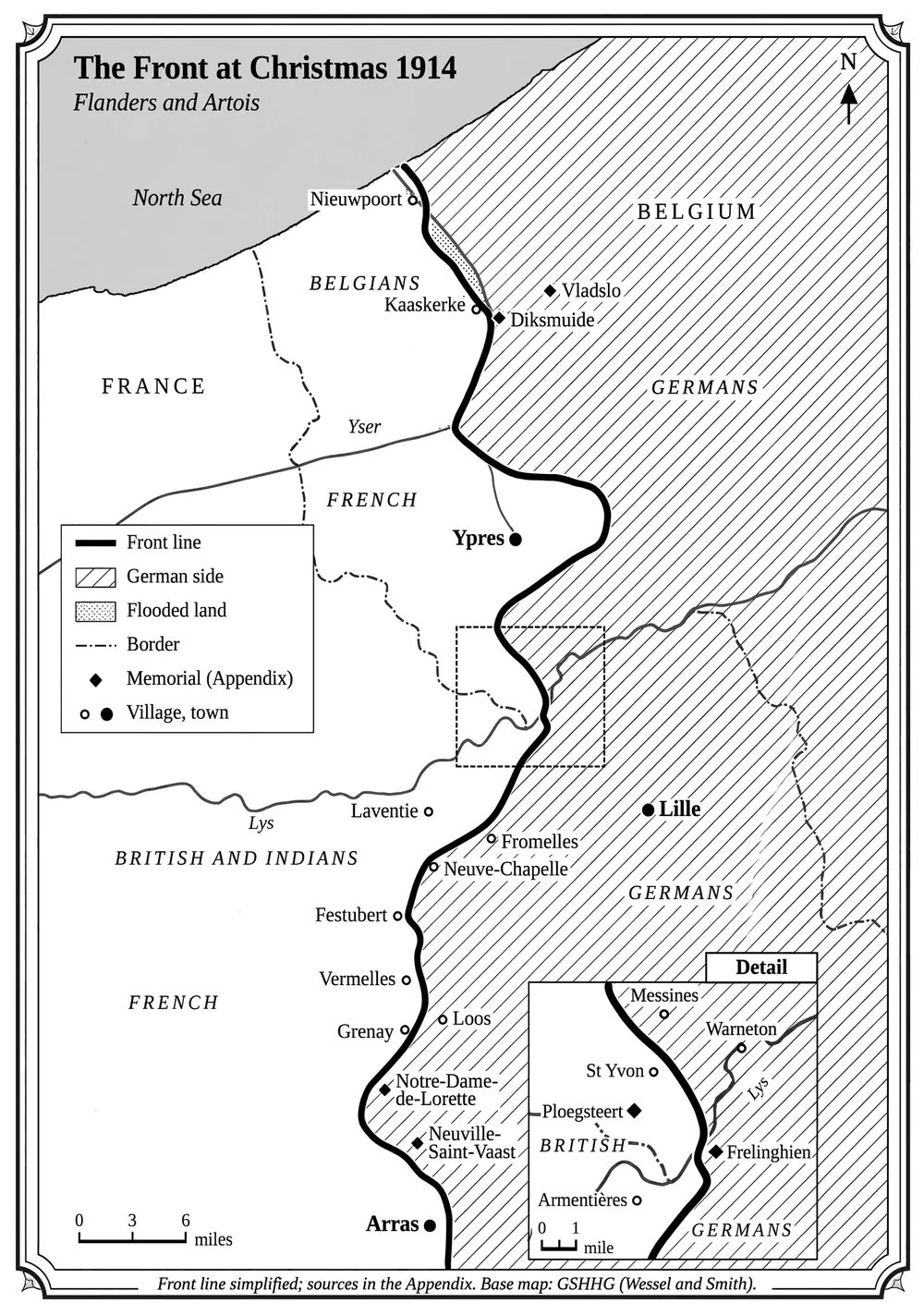
In many places it began on the evening of 24 December and reached its height on Christmas Day. In some sectors it lasted only a few hours. In others the guns stayed quiet for several days.
How did it begin?
On Christmas Eve, German soldiers put lanterns and small Christmas trees with candles on the edge of their trenches. They sang carols, among them ‘Stille Nacht’, known in English as ‘Silent Night’. The British answered with carols of their own. Greetings were shouted across no man’s land, then invitations. At some point a first man left his trench without a rifle, and others went after him.
On Christmas Day the men met in the open. Gifts changed hands: cigarettes and tobacco, food, and buttons and cap badges kept as souvenirs. In many places the first task was a sad one. The dead who had lain between the lines for weeks were finally buried, and in some places men from both armies stood together at the graves for a short service.
Was there really a football match?
The picture of British and German soldiers playing football in no man’s land has become the symbol of the truce. Several letters and diaries do mention kicking a ball about with the enemy. A proper match, with teams, a referee and a final score, is much harder to prove, and some men at the time even denied that a truce had happened at all.
What happened after the Christmas Truce?
The truce ended as it had begun, place by place. The commanders were alarmed. Orders followed at once to stop any repeat: British soldiers were threatened with court martial, German soldiers were warned they could be shot.
At Christmas 1915 a few small truces still happened, despite strict orders. Units that took part were punished, for example by having their leave stopped. Nothing on the scale of 1914 ever happened again. The war did not end until November 1918.
Was there a Christmas truce in the Second World War?
Not on anything like the scale of 1914. The best-known story comes from Christmas Eve 1944 in the Hürtgen Forest, near the German–Belgian border. A twelve-year-old boy, Fritz Vincken, and his mother were sheltering in a forest cottage when three lost American soldiers arrived, one of them wounded, followed by four German soldiers. The mother insisted on peace under her roof, and the enemies shared a Christmas meal. Fritz Vincken published the story in Reader’s Digest in 1973. It rests on his account alone; the official records do not mention it.
Christmas Truce memorials you can visit today
- Saint-Yvon near Ploegsteert, Belgium: a memorial unveiled by European football’s governing body, UEFA, in December 2014, a hundred years after the truce.
- Frelinghien, northern France: a memorial inaugurated on 11 November 2008 in the presence of grandchildren of the British and German commanders who faced each other there.
- Neuville-Saint-Vaast, northern France: a monument to the fraternisations of the whole war, inaugurated in December 2015, with life-size figures of French, British and German soldiers and a football.
- Liverpool, England: ‘All Together Now’, a bronze by Andy Edwards in the garden of St Luke’s Church, shows a British and a German soldier reaching out to shake hands over a football.
Letters from the front
The truce is best understood through the words of the men who were there. Our free teaching resource puts three letters side by side, from a German volunteer, a British officer and a French teacher, with a map and a timeline. Go to the teaching resource
The Christmas Truce in film, music and advertising
The truce has inspired the film Joyeux Noël (2005), John McCutcheon’s song ‘Christmas in the Trenches’, Sabaton’s ‘Christmas Truce’ and Sainsbury’s Christmas advert of 2014, made with the Royal British Legion.
The book: The First to Stand Up
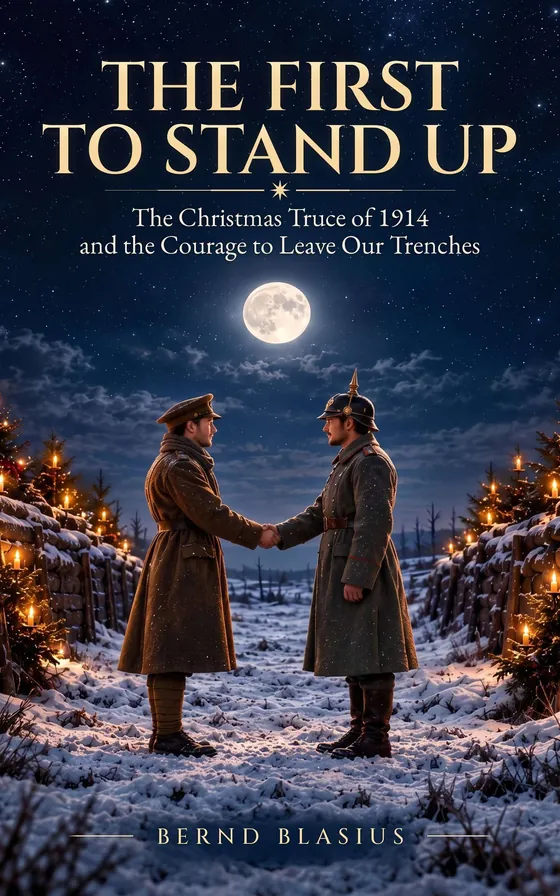
The First to Stand Up – The Christmas Truce of 1914 and the Courage to Leave Our Trenches by Bernd Blasius tells the story of that night from the letters and records of the men who lived it, and asks what it means for the trenches we dig at our own tables.
Read a sampleMore about the book
Order here
Coming soon. The order links will appear here.
In paperback, hardback and as an e-book.
Also on
The e-book is also available from Apple Books, Kobo and other shops.
As an Amazon Associate I earn from qualifying purchases.
Sources
Checked on 1 November 2026.
- NPR: A Century Ago, When The Guns Fell Silent On Christmas (25 December 2014)
- The National Archives: The game of Christmas football on the Western Front
- Ian Jones, Great War Forum: Christmas Truce 1914 – Gunners (artillery war diaries, IWM photograph HU 35801)
- The Long, Long Trail: Legends, myths and realities – the Christmas Truce, 1914
- Wikipedia: Christmas truce (estimates; Belgian, French and Eastern Front accounts after Max Hastings)
- Iron Time: 1914 – The Forgotten Christmas Truce (Belgians on the Yser)
- Western Front Association: William Ewart on the second Christmas truce, 1915
- American Battle Monuments Commission: Christmas Eve 1944, a brief moment of peace
- Jamaica Observer (AFP): WWI Christmas Truce football match memorial unveiled (10 December 2014)
- Traces of War: Memorial Christmas Truce 1914, Frelinghien
- Ministère des Armées: the fraternisation monument at Neuville-Saint-Vaast
- Art UK: All Together Now, Liverpool