Two titles to choose from
ASilent Night in No Man’s Land
BWhich of us would have been the first to stand up?
On Christmas Eve 1914, soldiers on the Western Front climbed out of their trenches and shook hands with the enemy. An extract from The First to Stand Up by Bernd Blasius.
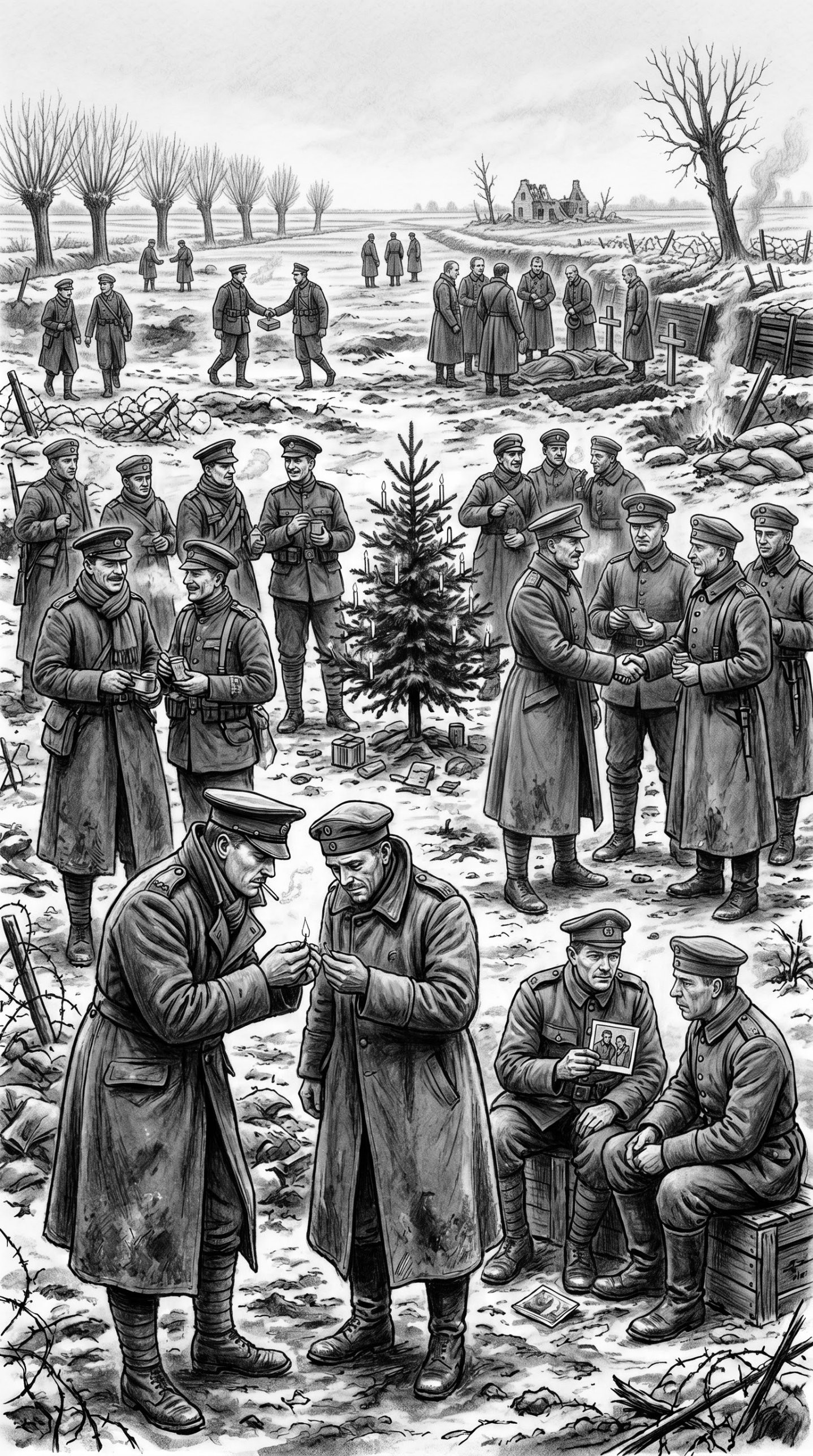
On Christmas Eve 1914 the moon hung over the fields around Armentières. It was the first bright night for a long time, clear and bitterly cold. In the British trenches the sentries stood, rifles in numb fingers, eyes on the other side. Ready for anything. Anything but what came.
At some point in the evening, lights appeared on the German side. Candles, on little Christmas trees set up along the trenches, one beside the other. Then, over there, they began to sing: ‘Stille Nacht, heilige Nacht’ – ‘Silent Night’. Joseph Mohr, a young curate, had written the words in a land with two decades of war behind it; the song was first sung at Midnight Mass in Oberndorf, near Salzburg, in 1818. That night it carried across no man’s land.
A few miles away, at St Yvon, a young British officer, Bruce Bairnsfather, heard a voice in the darkness call out in English, with a strong German accent: ‘Come over here!’ A sergeant called back those very words. Out of the darkness came the answer: ‘You come half-way – I come half-way.’
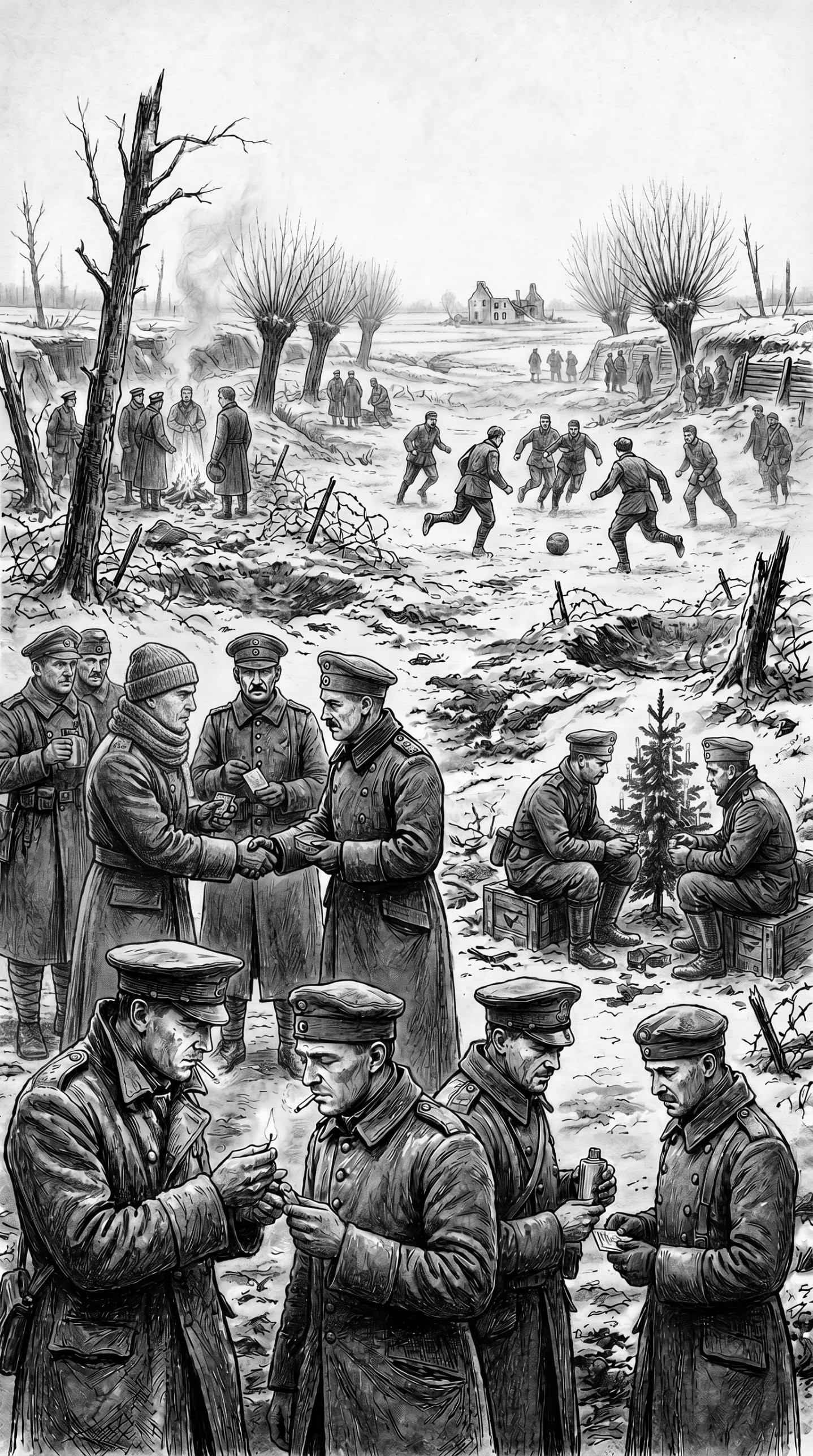
On the German side, Lieutenant Kurt Zehmisch, a trainee teacher from the Vogtland, recorded in his diary what happened next: a few men on each side climbed out of their trenches. In the middle of no man’s land they shook hands and wished each other a happy Christmas.
I do not know which of them held out his hand first. I only know that they did. There they stood, in the middle of the night, on the frozen ground between the trenches, a few men from Saxony and a few from England. For months each had been no more to the other than a shadow behind sandbags. Now each stood face to face with a human being. Cold hands found other cold hands, and the handshake was warm.
On Christmas morning, in many places, no man’s land was soon full of men. But the first thing many of them did out there was not for the living. In a flooded cabbage field the dead of both sides were carried to a ditch that ran down the middle. Each side carried the other’s dead.
When the graves had been filled in, the chaplain of a Scottish regiment, J. Esslemont Adams, led a short service, and the Twenty-third Psalm was read: ‘The Lord is my shepherd; I shall not want.’ A German theology student translated for his comrades. At the ditch stood men who for weeks had been meant to kill one another, hearing the same psalm, once in English, once in German.
There are no front lines at a graveside. There are only people who have lost someone.
Not everywhere did the guns fall silent, and the war went on for almost four more years. Which of us would have been the first to stand up? The courage of these men was not the courage of the hero who charges. It was the courage of the man who makes himself vulnerable. Empty hands say: I will not hurt you. And they ask: Will you hurt me?
There are two ways to get up from a festive table: to leave early, or to go across. Sometimes the person you are waiting for sits only a few places away, and for years the two of you have talked about the weather. Sometimes they no longer sit at any table where you sit. Then the way across is longer. It still begins with a single sentence.
Going across is not right at every table. At a table with no middle ground, standing up can mean staying upright and drawing a boundary. At many other tables it is what it was in 1914: the first step out of your own trench.
From: Bernd Blasius, The First to Stand Up: The Christmas Truce of 1914 and the Courage to Leave Our Trenches (2026). Paperback £9.99 and hardback £16.99 from Amazon; e-book from Amazon, Apple Books, Kobo and other shops. More at humane-world-formula.com/the-first-to-stand-up